
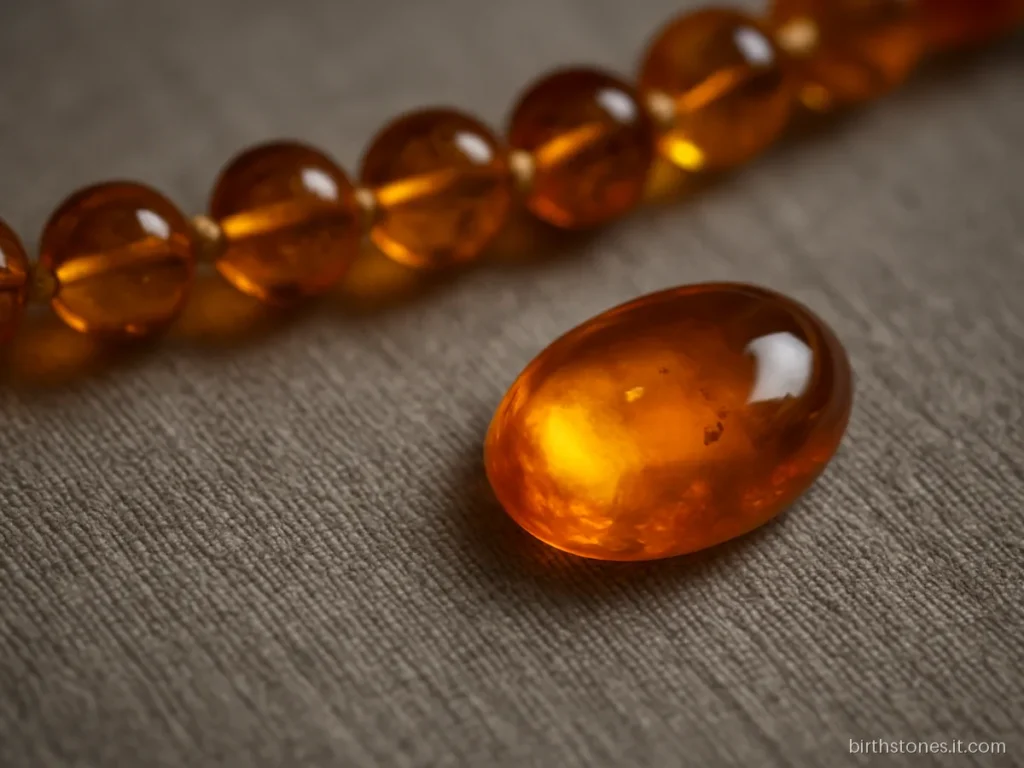
Amber stone benefits are beliefs handed down over centuries: people wear this golden fossil resin for a feeling of warmth, calm and protection, and many simply love how light and soft it feels on the skin. None of these ideas has been proven, and some popular uses, such as amber beads for babies, carry real safety risks.
Amber is not a mineral but tree resin that hardened underground over millions of years. Hindi and Urdu speakers often know it as kahruba. Below we cover the beliefs, how people wear it, a clear safety section and gentle care. For the material itself and testing tips, see the main amber stone page.
Where amber stone benefits beliefs come from
Amber feels warm in the hand and glows like honey in sunlight, so many cultures saw it as a piece of captured sun. Around the Baltic Sea, families gave amber beads as charms for luck and protection. Traders carried it across Europe and Asia, and it reached India through old trade routes, where the name kahruba took hold. Rubbed on cloth, amber picks up a static charge and attracts bits of straw, which seemed magical in the past; the Greek word for amber gave us the word electricity.
Amber in crystal practice today
Crystal users class amber as a warm, grounding material. These are the beliefs most often shared:
- It is said to lift mood and bring a sunny, settled feeling.
- Some believe it absorbs negative energy and keeps the wearer calm.
- It is linked with the solar plexus and sacral chakras in their system.
- Pieces with trapped insects or leaves are treasured as a connection to ancient life.
Each item above is faith and feeling, never measured. It is fine to enjoy amber for how it makes you feel, but it should not be expected to change health, money or relationships.
Safety first: amber and babies
Amber teething necklaces are sold with the idea that the skin absorbs something soothing from the beads. There is no good evidence for this. More important, child health experts warn that any necklace or bracelet on a baby or small child carries a risk of strangling and choking if a bead comes loose. Please do not put amber beads on infants. If a baby is in discomfort from teething or anything else, speak with a doctor or child specialist. The same goes for adults: amber is not a treatment, and medical problems need medical care.
How people commonly wear amber
Amber is soft, so it is usually cut as beads or smooth cabochons rather than faceted rings for heavy daily use.
| Form | Why chosen | Practical note |
|---|---|---|
| Bead necklace | Light even when long | Knotted silk keeps beads from scattering |
| Pendant | Shows the glow and any inclusion | Protect from scratches |
| Bracelet | Warm against the wrist | Remove for washing up |
| Silver ring | Popular with warm tones | Best for occasional wear |
The nine navratna leave amber out, so old astrology books give it no ruling body. Some modern astrologers loosely link it with the Sun because of its colour. Anyone planning to wear it for planetary reasons should first talk it over with a trusted Jyotish reader.
Colours and what they are thought to mean
Amber comes in more shades than most people expect, and crystal sellers attach small beliefs to each.
- Honey and golden: the classic warm, cheerful amber.
- Cognac and dark brown: seen as steady and grounding.
- Milky butterscotch: cloudy from tiny air bubbles, prized in some old jewellery.
- Green or blue tinted: rare natural tones, often from particular sources; many green pieces are heat treated.
- Cherry red: usually heated or dyed.
Is your amber real? Why it matters for belief
Plastic, resin, glass and young copal are all sold as amber. If you value amber for its age and natural origin, a fake defeats the purpose. Simple signs: real amber is very light, feels warm, and often floats in strongly salted water while most plastics and glass sink. Copal is much younger resin that may turn sticky with a drop of solvent. Avoid hot needle tests on jewellery; they damage the piece. For costly items, ask a laboratory to confirm it.
Gentle care for soft amber
At 2 to 2.5 on the Mohs scale, amber scratches easily and reacts badly to chemicals. A soft cloth, barely damp with tepid water, then a dry one, is all the cleaning it should get. Ultrasonic tanks, steam, spirit, hair spray and scent all harm it, and put amber on after makeup. Keep it out of hot cars and direct strong sun, which can darken or crack it. Wrap every piece separately in cloth.
Amber compared with other warm stones
People who like amber often look at other honey, orange and red stones too. They differ a lot in what they are made of and in the beliefs attached, as the table shows.
Questions people ask
What are the main amber stone benefits people believe in?
Wearers link amber with warmth, calm, protection and a settled mood. These come from old custom and modern crystal lore, not from trials.
What is amber called in Hindi?
It is commonly called kahruba, also written kaharva. Many shops simply use the English word amber.
Are amber teething necklaces safe for babies?
Health experts advise against them because of choking and strangling risks, and there is no proof they ease teething. Ask a doctor about a baby's teething pain.
Can amber be worn every day?
Beads and pendants suit daily wear, though the softness means it should come off for cooking, the gym and bath time, and stay clear of scent sprays.
Is amber a gemstone or a crystal?
Neither in the strict sense. It is an organic gem made of fossilised tree resin, like pearl and coral are organic gems from animals.
Which planet is amber linked with?
Traditional Vedic texts do not list it. Some modern astrologers link it with the Sun because of its golden colour; ask your astrologer before wearing it for that reason.