
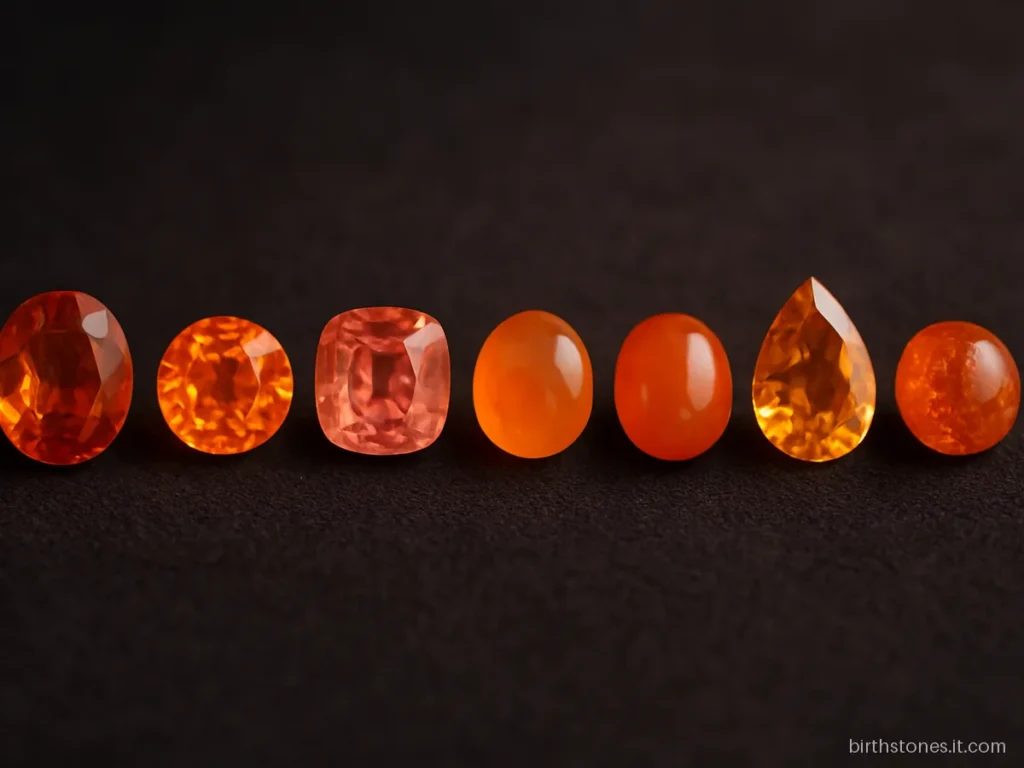
An orange gemstone is a colour group, not one mineral: the names you meet most are hessonite (gomed), spessartite garnet, orange sapphire, fire opal, carnelian, deep citrine and sunstone, with orange zircon, imperial topaz, orange spinel and amber close behind. Side by side in a dealer's tray they can pass for cousins, yet they differ a lot in hardness, care, value and astrological use.
This page gives you the orange stone name table, a quick way to tell them apart, the Jyotish links that some of them carry, and which ones suit an everyday ring. Each name links to its full guide on this site.
Orange gemstone names table
| Stone | Typical shade | Hardness | Mineral | Hindi or trade name |
|---|---|---|---|---|
| Hessonite | Honey to cinnamon orange, often brownish | Mohs 6.5 to 7.5 | Grossular garnet | Gomed |
| Spessartite garnet | Bright orange to reddish orange | Mohs 6.5 to 7.5 | Manganese garnet | Mandarin garnet |
| Orange sapphire | Pure orange or salmon pink orange | Mohs 9 | Corundum | Padparadscha when pinkish orange |
| Fire opal | See through yellow to red orange | Mohs 5.5 to 6.5 | Hydrated silica | Mexican opal |
| Carnelian | Translucent orange to red orange | Mohs 6.5 to 7 | Chalcedony | Lal hakik, aqeeq |
| Citrine (deep shades) | Golden to brownish orange | Mohs 6.5 to 7 | Quartz | Sunela |
| Sunstone | Orange with glittering spangles | Mohs 6 to 6.5 | Feldspar | Surya kant mani in some shops |
| Orange zircon | Bright orange, strong fire | Mohs 6 to 7.5 | Zircon | Upratna for gomed |
| Imperial topaz | Golden orange to peach | Mohs 8 | Topaz | Sunehla topaz |
| Orange spinel | Vivid orange to orange pink | Mohs 8 | Spinel | Spinel |
| Amber | Honey orange, warm and light | Mohs 2 to 2.5 | Fossil tree resin | Kahruba |
Note that the trade names in the second column vary by city and seller. Always check what mineral a seller means.
Telling orange stones apart
A gem tester uses a refractometer and a microscope, but a few plain clues help a buyer:
- Hessonite shows a treacly, swirly look inside, as if syrup were stirred into it. Gem testers call this the heat wave effect.
- Spessartite is brighter and cleaner orange, with no brown cast in good stones.
- Orange sapphire is very hard and crisp edged, often with tiny silk needles under a loupe.
- Fire opal glows from within and feels lighter in the hand.
- Carnelian is translucent, not fully clear, and is usually cut as a cabochon or bead.
- Citrine in deep shades is often heated amethyst and may show bands of colour.
- Sunstone has glittering flat spangles that flash as you tilt it.
- Amber is warm, very light and can float in salty water.
Orange glass and orange cubic zirconia imitate all of these. Bubbles, swirls, too much rainbow fire or an odd weight are the usual giveaways.
Orange gemstones in Jyotish
Only one navratna is orange: gomed, the hessonite garnet, which is linked with Rahu in Vedic astrology. Astrologers name orange zircon as its common substitute. Carnelian, thanks to its red orange body, is a popular budget swap for moonga (Mars). Some sellers tie sunstone, and orange stones generally, to the Sun; old Jyotish texts say nothing of the kind. Whether any of them belongs on your hand, and at what weight, is for a chart reading astrologer to judge. Read stone for Rahu for the gomed tradition.
Orange stones and birth months
Modern month lists do not give any month a truly orange gem. A few links do exist:
- November: topaz (citrine is its second choice), and golden orange imperial topaz fits here.
- January: garnet, and spessartite belongs among the garnets.
- October: opal, so fire opal suits October birthdays.
- Virgo sun sign lists sometimes add carnelian.
See the birthstone chart for the full list.
Which orange gemstone suits daily wear
| Use | Good picks | Handle with care |
|---|---|---|
| Everyday ring | Orange sapphire, spinel, imperial topaz | Fire opal, amber |
| Pendant or earrings | Almost any, including fire opal and sunstone | Amber near perfume |
| Bead bracelet | Carnelian, citrine, sunstone | Amber in hot cars |
| Jyotish ring | Gomed or orange zircon, as advised | Any stone sold without the mineral name |
Common treatments in orange gems
Heating is common in orange sapphire, citrine, zircon and carnelian, and it is generally stable. Some orange sapphires get their colour from beryllium diffusion, a deeper treatment that lowers value a lot and needs a lab to detect. Carnelian is sometimes dyed agate. Topaz can be heated or coated. Ask each seller to write any known treatment on the bill, and get an independent lab report for costly stones such as padparadscha.
Caring for orange stones
Sapphire, spinel and topaz in orange can be scrubbed lightly with an old toothbrush in a bowl of soapy lukewarm water. Fire opal and amber want nothing more than a moist cloth, and dislike heat, sprays and solvents. Carnelian and citrine are fine with mild soap but can fade if heated. Keep softer stones in separate pouches so the harder ones do not scratch them.
Questions people ask
Which orange stone appears in Vedic astrology?
Gomed, the hessonite garnet, is the orange navratna, linked with Rahu. Orange zircon is its usual substitute. Carnelian also turns up in Jyotish shops as a stand in for moonga.
Which orange gemstone fetches the most?
Top padparadscha sapphire, a pinkish orange corundum, is usually the most valued. Bright spessartite and imperial topaz are also prized.
Is citrine orange?
Most citrine is yellow, but deeper stones are golden orange to brownish orange. Many of these deep shades come from heated amethyst.
Should fire opal go in a ring?
Its hardness is only around 6, and a knock or sudden heat may crack it. A protective setting or a pendant is a safer choice.
Could my orange stone be glass?
Under magnification, spherical air pockets and flow swirls point to glass. Glass also warms quickly in the hand. A gem lab can confirm the mineral.
What is an orange stone name in Hindi?
Gomed is the best known. Carnelian is called lal hakik or aqeeq, citrine is sunela, and amber is often called kahruba.