
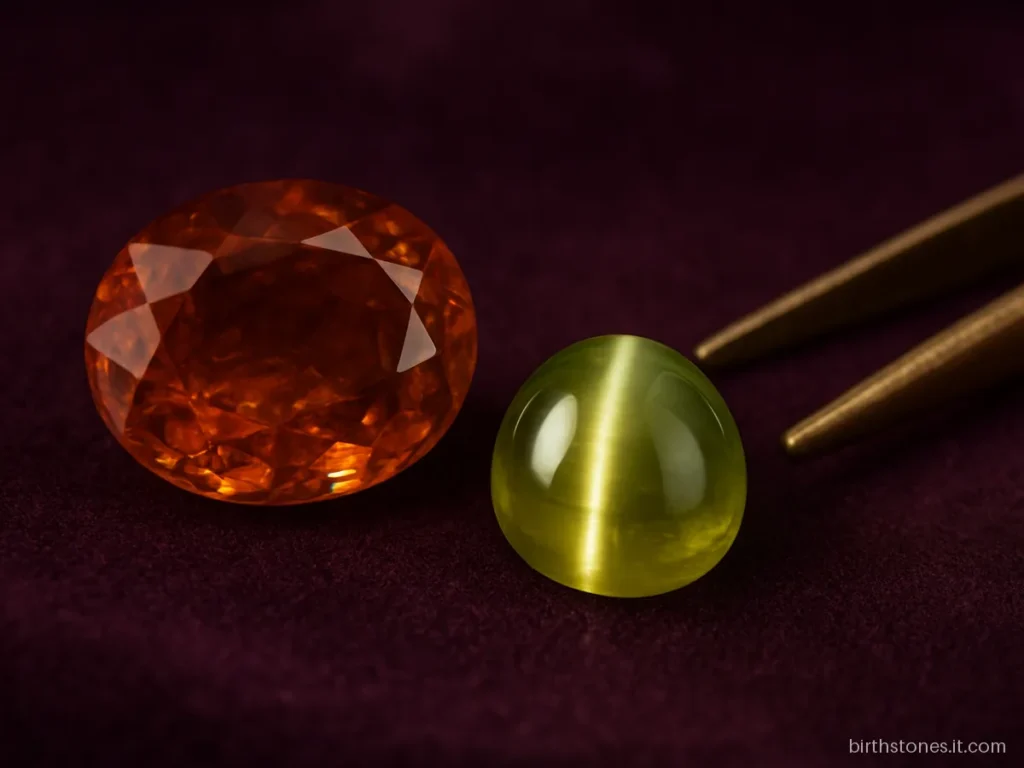
The traditional stone for Rahu is gomed, a honey brown to orange hessonite garnet, and its partner node Ketu is given lahsuniya, the chrysoberyl cat's eye. Both belong to the nine navratna gems of Vedic astrology (Jyotish).
This page lists what each gem is as a mineral, the Rahu gemstone and Ketu gemstone customs people follow, the gems for the seven other planets, and the cautions that astrologers themselves give before anyone wears these two stones.
How a gomed is usually checked before it is worn
- Look at the colour against white paper
Good hessonite shows a clear honey, cinnamon or orange brown. Very dull brown or a flat, even orange can point to glass or a different stone.
- Peer inside through a 10x jeweller's lens
Hessonite often shows a wavy, syrup like look inside, which jewellers call treacle. Round gas bubbles suggest glass.
- Ask what the seller means by gomed
Some sellers pass off orange zircon or synthetic material as gomed. Ask in writing for the mineral name.
- Get a report for a costly piece
A lab paper, from testers who are not selling you the stone, can confirm grossular garnet and list any treatment.
- Let the astrologer decide the rest
Weight, finger and the day to start are set by an experienced astrologer after reading the full chart.
Which is the stone for Rahu, and why gomed
Most Jyotish texts and nearly every gem shop in India name gomed as the gem for Rahu. Gomed is hessonite, the orange to brown kind of grossular garnet. Older books compare its colour to cow's urine, which is where the name comes from, but today buyers simply ask for honey or cinnamon tones.
Rahu and Ketu are not solid planets. They are the two points where the Moon's path crosses the Sun's apparent path in the sky, so astronomers call them the lunar nodes. Eclipses happen near these points, and that is one reason the tradition treats both nodes with caution.
Lahsuniya, the Ketu gemstone
Ketu is paired with lahsuniya. In Jyotish this means chrysoberyl cat's eye, a hard stone with a single bright line of light that slides across the dome when you tilt it. Greenish yellow and honey shades with a sharp, centred eye are the most wanted. Quartz cat's eye and glass fibre imitations are sold under the same name, so a lab check is wise.
Both gems have their own guides: the cat's eye stone and the gomed stone.
All nine planets and their gems
People often search for one gem at a time, such as the sun gemstone or the venus gemstone. Here is the whole set in one place, as most astrologers list it. The full background sits on our navratna stones page.
| Planet | Gem (Hindi name) | Mineral | Common upratna |
|---|---|---|---|
| Sun (Surya) | Manik | Ruby, corundum | Garnet or red spinel |
| Moon (Chandra) | Moti | Pearl, organic | Moonstone |
| Mars (Mangal) | Moonga | Red coral, organic | Carnelian |
| Mercury (Budh) | Panna | Emerald, beryl | Peridot or green onyx |
| Jupiter (Guru) | Pukhraj | Yellow sapphire, corundum | Yellow topaz or citrine |
| Venus (Shukra) | Heera | Diamond | White sapphire or zircon |
| Saturn (Shani) | Neelam | Blue sapphire, corundum | Amethyst or iolite |
| Rahu | Gomed | Hessonite garnet | Orange zircon |
| Ketu | Lahsuniya | Chrysoberyl cat's eye | Tiger's eye |
Each astrologer keeps a slightly different substitute list, so treat the last column as a common pattern rather than a rule.
What people believe a Rahu gemstone does
In Jyotish, Rahu stands for desire, sudden change, foreign links and confusion, and Ketu for detachment and the inner life. Followers believe a well chosen gomed helps a person whose chart shows a strong but troubled Rahu, and many wear it for focus at work or calm during a Rahu period (mahadasha). Lahsuniya is believed by its wearers to protect against sudden setbacks.
All of this is faith passed down in families, not something measured. A ring has no way to secure a job or wealth, and when you feel unwell the right step is a visit to a doctor, with or without a stone on your hand.
Cautions astrologers give
- Never by default. Both node stones are given only after a full chart reading, never because of a birth month or a sun sign.
- Trial period. Many astrologers ask for a few days of trial with the stone kept close, much as neelam is traditionally tried first.
- Pairing. Some schools avoid wearing gomed or lahsuniya together with manik, moti or moonga. Ask your astrologer.
- Removal. If the wearer feels uneasy, the usual advice is to take it off and go back to the astrologer.
Traditional way of wearing gomed and lahsuniya
Common practice is a silver or panchdhatu ring whose open back lets the gem rest against skin. Gomed goes on the middle finger and is usually first worn on a Saturday. Lahsuniya sits on the middle finger, or the little one in some schools, starting on a Tuesday or a Thursday depending on the school. Some households mark that first morning with a short ritual of their own, and the astrologer can tell you about it. Weight in carat or ratti is fixed by the same astrologer; check which ratti the seller counts by, since that unit is not fixed.
Spotting fakes and caring for both stones
Gomed fakes are mostly orange glass and cubic zirconia. Lahsuniya fakes include glass with fibres set in it and dyed or bleached quartz cat's eye, whose line of light is usually softer and broken. Cleaning is simple: lukewarm suds, a soft old toothbrush, then clean water and a towel pat. Keep hessonite in its own pouch, because harder gems in the same box can scratch it.
Questions people ask
What is the best stone for Rahu?
Tradition names gomed, which is hessonite garnet. Orange zircon is the common upratna. Whether you should wear either is something only a chart reader can judge after studying your whole kundli.
Which gemstone is for Ketu?
Lahsuniya, the chrysoberyl cat's eye, is the Ketu gemstone in Jyotish. Tiger's eye, much easier on the pocket, is the usual Ketu upratna.
Can I wear gomed and lahsuniya together?
Some astrologers allow it and others do not, since the two nodes sit opposite each other in the chart. Follow the advice of the person reading your chart.
Which is the sun gemstone and the venus gemstone?
The Sun is linked with manik (ruby) and Venus with heera (diamond). White sapphire and zircon are commonly offered in place of diamond.
Is a Rahu gemstone dangerous?
The stone itself is a harmless mineral. The caution in tradition is about wearing it without a proper chart reading, which is why tradition asks for a trial run and a proper reading first.
Which day is used to start wearing gomed?
Saturday is the usual day to start wearing gomed. Timings vary by school, so the astrologer sets them for each person.