
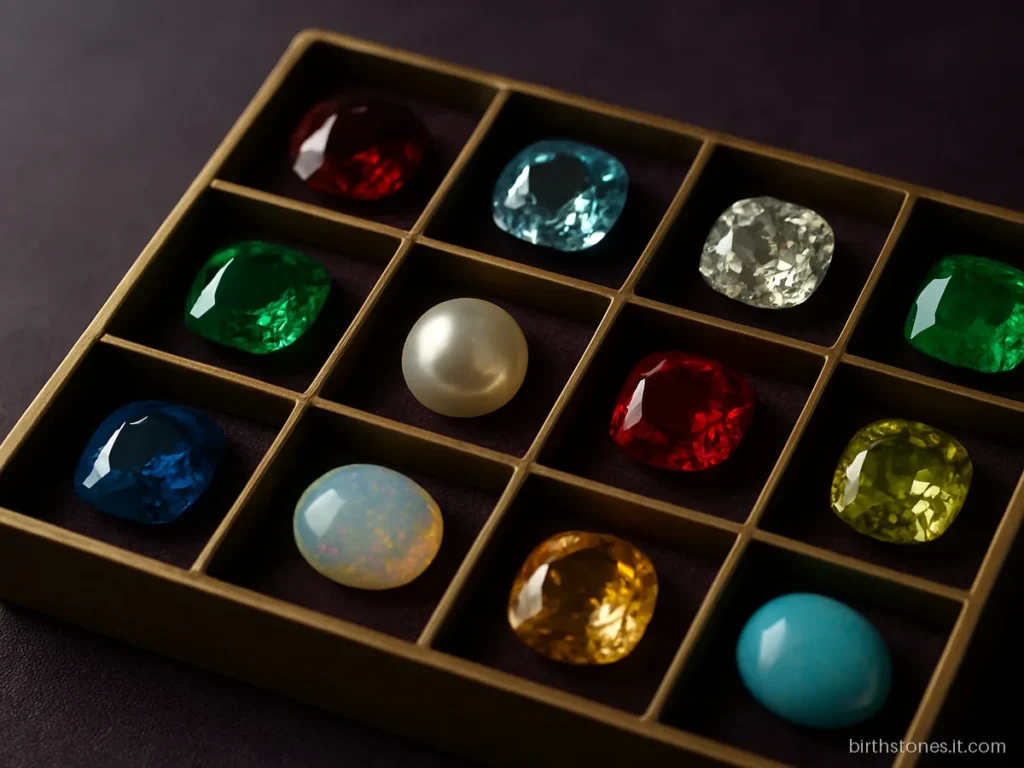
A birthstone chart gives one gem for each calendar month, from garnet in January to turquoise in December, and most modern charts add older alternatives for June, August, October, November, December and March.
Below you will find the full month wise birthstone list with colours and meanings, a hardness table for daily wear, the Hindi names jewellers use in India, and a short page for every month. If you only want your own answer, the birthstone finder works it out from a date of birth.
Birthstone chart by month and meaning
This is the list most modern charts use, and the one people mean when they search birth stone by month. The third column holds earlier or additional picks still used by some jewellers and in some countries. The meanings are traditions and popular beliefs, not proven effects, so read them as the story behind each gem.
| Month | Modern stone | Traditional alternatives | Usual colour | Meaning in popular belief |
|---|---|---|---|---|
| January | Garnet | None in most lists | Deep red, also orange and green | Loyalty, steady friendship |
| February | Amethyst | None in most lists | Light lilac to deep purple | Calm mind, clear thinking |
| March | Aquamarine | Bloodstone | Pale sea blue to blue green | Courage, peace near water |
| April | Diamond | None in most lists | Colourless, rarer yellow or pink | Lasting love, strength |
| May | Emerald | None in most lists | Grass green to deep bluish green | Growth, renewal, fresh starts |
| June | Pearl | Moonstone, alexandrite | Creamy white, pink, silver, black | Purity, a gentle nature |
| July | Ruby | None in most lists | Pinkish red to blood red | Passion, warmth, vitality |
| August | Peridot | Spinel, sardonyx | Olive to lime green | Light after dark times |
| September | Sapphire | None in most lists | Royal blue, plus other colours | Wisdom, honesty, loyalty |
| October | Opal | Tourmaline | Milky white with flashes of colour | Hope, creativity |
| November | Topaz | Citrine | Golden yellow, orange, blue | Friendship, warmth |
| December | Turquoise | Tanzanite, zircon | Sky blue to blue green | Protection on journeys |
Sources do not all agree. Some older lists give bloodstone for March, sardonyx for August and zircon for December as the first choice. Tap any month to open its own page with buying and care notes.
Birthstone colors by month at a glance
If you are picking a gift by colour, it helps to see the twelve months as a palette. Three months sit in the red family: January garnet, July ruby and, for October births who prefer it, pink or red tourmaline. Purple belongs to February. Blues run through March aquamarine, September sapphire and December turquoise or tanzanite. Green covers May emerald and August peridot.
White and colourless stones are April diamond and June pearl. October opal mixes every colour in its play of light, and November topaz and citrine bring golden yellow and orange. A sapphire need not be blue: the same mineral comes in yellow, pink, green and white, and in India yellow sapphire is sold as pukhraj.
Birthstone chart by date: does the day matter
A month birthstone depends only on the month. Someone born on 1 March and someone born on 31 March both get aquamarine. So a birthstone chart by date is really the same chart, read by month.
The day of birth does matter for a different list, the western sun sign stones. A person born on 25 March is an Aries in that system, linked with diamond, while the month list gives aquamarine. Both answers can be right because they come from two separate traditions. The zodiac stone chart explains the sun sign list, and the finder shows both results together for one date.
Why two months can have more than one birthstone
Older European lists often gave a cheaper or easier stone for a month, and trade groups later added new gems so that buyers had a wider choice. That is why June now carries pearl, moonstone and alexandrite, and why December can be turquoise, tanzanite or zircon.
There is no rule that you must use the first stone on the list. Many people choose the alternative that suits their budget, their skin tone or their daily routine. A teacher who writes on a board all day may prefer a hard spinel over a soft pearl, for example.
- June: pearl is soft, moonstone has a blue sheen, alexandrite changes colour in different light.
- August: peridot is green, spinel comes in many colours and is harder, sardonyx is banded red and white.
- October: opal is delicate, tourmaline is tougher and comes in pink, green and mixed colours.
- November: topaz and citrine can look alike in yellow, but they are different minerals.
Hardness of each month stone for daily wear
Hardness on the Mohs scale tells you how well a stone resists scratches. Dust contains quartz, which is about 7, so anything softer than 7 slowly loses its polish if worn every day without care.
| Stone | Daily wear note | Mohs hardness |
|---|---|---|
| Garnet | Fine for rings with some care | 6.5 to 7.5, varies by type |
| Amethyst | Good for daily rings and pendants | 6.5 to 7 |
| Aquamarine | Tough enough for everyday wear | 7.5 to 8 |
| Diamond | The hardest, still can chip on a sharp knock | 10 |
| Emerald | Hard but brittle, often oil filled, avoid knocks | 7.5 to 8 |
| Pearl | Soft and organic, keep away from perfume | 2.5 to 4.5 |
| Ruby | Very durable for daily wear | 9 |
| Peridot | Scratches over time, better in pendants | 6.5 to 7 |
| Sapphire | Very durable for daily wear | 9 |
| Opal | Delicate, dislikes heat and sudden dryness | 5.5 to 6.5 |
| Topaz | Hard but can split along one direction | 8 |
| Turquoise | Porous, usually stabilised, wipe only | 5 to 6 |
Hardness is not the whole story. Emerald is hard but has natural fractures, and topaz can split if hit at the wrong angle. A bezel setting that wraps the edge of the stone protects these better than tall prongs.
Hindi and trade names on a birthstone list
Indian jewellers often use Hindi or Urdu trade names. Knowing them helps when you compare a western birthstone list with what a local seller calls the stone.
| Birthstone | Name heard in India | Note |
|---|---|---|
| Garnet | Tamda or garnet | Also an upratna for manik |
| Amethyst | Jamunia | Named after the jamun fruit colour |
| Aquamarine | Beruj | Same mineral family as panna (beryl) |
| Diamond | Heera | One of the navratna gems |
| Emerald | Panna | One of the navratna gems |
| Pearl | Moti | One of the navratna gems |
| Ruby | Manik | One of the navratna gems |
| Peridot | Zabarjad | Sometimes offered as a panna substitute |
| Sapphire | Neelam (blue), pukhraj (yellow) | Both are corundum |
| Opal | Opal | Sometimes named for Venus as a heera substitute |
| Topaz | Topaz, yellow ones often sold as sunela | Not the same as pukhraj |
| Turquoise | Feroza or firoza | People also search feroza stone |
Five of the twelve month stones, diamond, emerald, pearl, ruby and blue sapphire, are also navratna gems. The navratna guide covers how those are used in Vedic astrology.
Month birthstones and Indian astrology are separate lists
The month chart is a western jewellery tradition. In Jyotish, the gem for a person comes from the planets in the birth chart, and the rashi used is usually the Moon sign, which cannot be read from the birth month. So a July baby gets ruby on the month chart, while an astrologer might suggest pearl, emerald or no stone at all.
If you want the Vedic view, start with the rashi stone chart and the gemstone calculator. For which gem to actually wear, how heavy and from when, families tend to sit down with a seasoned astrologer and go over the complete kundli together.
Every page in the birthstone chart section
Each month has its own page with colours, names, quality checks and care. The other pages here help with finding and setting your stone.
| Page | What it answers |
|---|---|
| Birthstones home | What a birthstone is and where to start |
| Birthstone finder | Your stone, sun sign stone and flower from one date |
| January birthstone | Garnet: colours, hardness and how to judge one |
| February birthstone | Amethyst, or jamunia, from pale to deep purple |
| March birthstone | Aquamarine and the older bloodstone choice |
| April birthstone | Diamond, natural or lab made, and what to ask |
| May birthstone | Emerald, called panna in India, and its oiling |
| June birthstone | Pearl, moonstone and alexandrite compared |
| July birthstone | Ruby, or manik, and how heating affects it |
| August birthstone | Peridot, spinel and sardonyx side by side |
| September birthstone | Sapphire in blue and other colours |
| October birthstone | Opal and tourmaline, and how to keep opal safe |
| November birthstone | Topaz and citrine, and why they get mixed up |
| December birthstone | Turquoise, tanzanite and zircon for winter births |
| Birthstone jewellery | Which metals and settings suit each month stone |
Simple care by stone type
Diamond, ruby, sapphire, topaz and aquamarine are tough enough to take a few minutes in a cup of lukewarm soapy water, then a light going over with an old soft brush, followed by a rinse and a pat dry using soft cotton.
Pearl, opal and turquoise need gentler handling. After each outing, give them a light wipe with moist cotton, never put them in an ultrasonic cleaner, and let perfume or deodorant dry on the skin before you put them on; the tava's heat is no friend of theirs either. Emerald is often oil treated, so skip hot water and steam for it too. Keep every piece wrapped separately, because loose jewellery jostles in a drawer and the harder gem always wins.
Questions people ask
What is the birthstone list for all months?
Reading the common modern chart in order: garnet (Jan), amethyst (Feb), aquamarine (Mar), diamond (Apr), emerald (May), pearl (Jun), ruby (Jul), peridot (Aug), sapphire (Sep), opal (Oct), topaz (Nov) and turquoise (Dec). A handful of months carry a second or third pick too, for instance spinel in August or tanzanite in December.
Is there a birthstone chart by month and date?
The month chart only needs the month. The date matters for the separate sun sign list, where your stone changes around the 20th to 23rd of each month. The birthstone finder shows both from one date.
Which month's birthstone costs the most?
April diamond and July ruby are usually the dearest in top grades, with May emerald close behind. What you pay depends far more on colour, clarity, size and treatment than on the month itself.
Why do different birthstone charts disagree?
Lists were made at different times by different groups, and some added new gems later. Most modern charts agree on the main stone for each month and differ mainly in the alternatives.
Can I wear a birthstone that is not from my month?
Yes. Birthstones are tradition rather than law, and many people simply wear the colour they like. Vedic gems are a separate matter that an astrologer advises on.
What are the birthstone colors and meanings in short?
Red garnet stands for loyalty, purple amethyst for calm, blue aquamarine for courage, clear diamond for lasting love, green emerald for renewal and white pearl for purity. The table above lists all twelve with their popular meanings.