
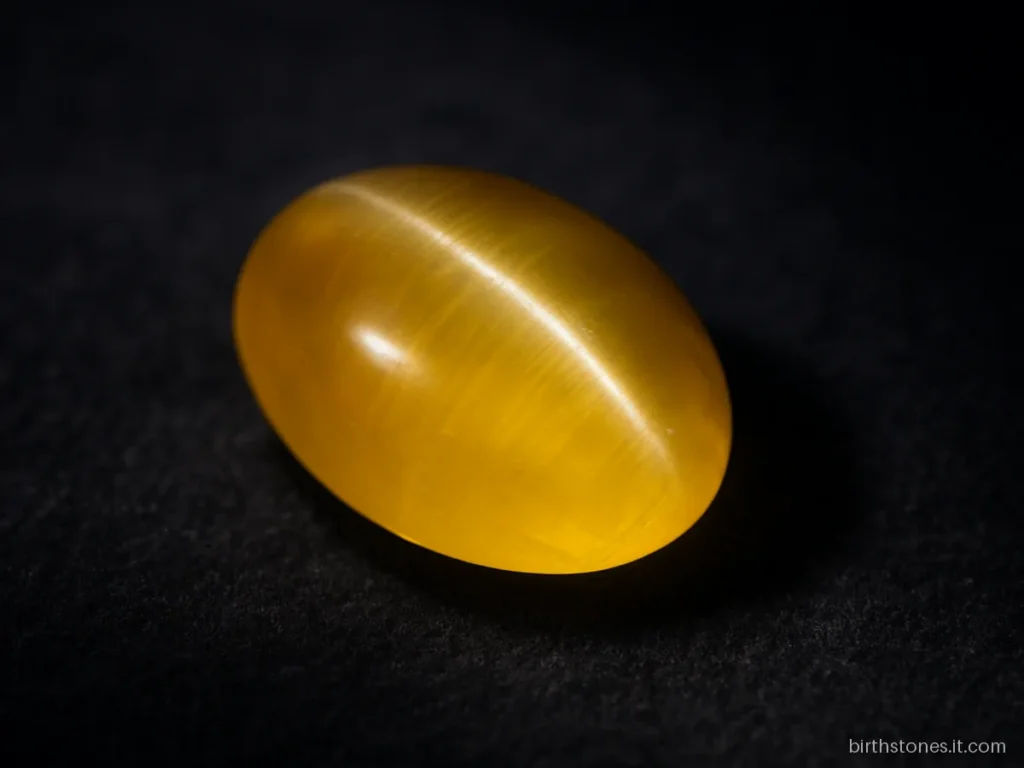
A cats eye stone, known in Hindi as lahsuniya, is a chrysoberyl cut as a smooth dome that shows one thin line of light sliding across its surface, like the slit pupil of a cat. Vedic astrology links this gem with Ketu, the south lunar node.
Several other minerals can show an eye too, so the word cat's eye on its own does not tell you much. This page explains which stone the navratna list means, how the effect forms, which colours are prized, and how a tester separates a real lahsuniya from glass. The beliefs are on the lahsuniya benefits page, and quote reading is on the cat's eye price guide.
Testing a lahsuniya under a single bulb
- Hold the stone under one point of light
A torch or a single bulb works best. Diffused tube light makes even a good eye look weak.
- Tilt it slowly from side to side
The line should glide across the dome and stay in one piece. On chrysoberyl it is usually thin, bright and silvery.
- Shine light from the side
On fine chrysoberyl, one half of the dome turns milky while the other half keeps its honey colour. Gem dealers call this the milk and honey look.
- Turn it over and look at the sides
Fibre optic glass often shows a honeycomb or hexagon pattern along its sides. Natural stones do not.
- Weigh it in your palm
Chrysoberyl feels noticeably heavy for its size. Quartz cat's eye of the same size feels lighter.
What a cats eye stone really is
Chrysoberyl is a hard mineral made of beryllium and aluminium oxide. Some crystals grow with countless fine, parallel needles or hollow tubes inside them. When a cutter shapes such a crystal into a dome with the needles lying flat, light bounces off them in one narrow band. That band is the eye, and gemmologists call the effect chatoyancy.
The same rough also gives faceted yellow chrysoberyl and, rarely, alexandrite, which changes colour. Only the domed stone with an eye is lahsuniya.
Lehsunia, vaiduryam and other names
| Name | Where used | Notes |
|---|---|---|
| Lahsuniya, lehsunia | Hindi speaking states | Navratna name; spellings vary |
| Vaiduryam | Kerala and Tamil Nadu | Vaiduryam stone in english is cat's eye chrysoberyl |
| Vaidurya | Old Sanskrit gem texts | Classical name |
| Cymophane | Gem books | Mineral term for chatoyant chrysoberyl |
| Catseye gemstone, cat eye gemstone | Online listings | Loose terms; check which mineral is meant |
Because spellings differ so much, people also search catseye stone, cats eye gemstone or cat's eye gemstone. They all lead back to the same chrysoberyl when the seller is honest.
Colours and types of cat's eye gemstone
- Honey yellow: the colour most astrology buyers ask for, with a sharp white eye.
- Greenish yellow or apple green: also valued, especially when translucent.
- Brownish or grey: more common and usually less costly.
Other minerals with an eye are sold under the same label. Quartz cat's eye is softer and lighter in weight. Tiger's eye is a banded quartz with a broad, shimmering sheen rather than a single line, and a number of astrologers offer it as the cheaper upratna. Apatite, tourmaline and sillimanite can also form eyes. For navratna use, astrologers ask for chrysoberyl.
Where lahsuniya is mined
Sri Lanka has long been the classic source, with stones washed out of river gravels. India produces chrysoberyl cat's eye in Odisha and Kerala. Brazil, Madagascar and Tanzania add a good share of what is sold. Origin is printed on some reports, but a stone from one country is not more real than another.
Ketu and lahsuniya in astrology belief
Jyotish counts Ketu, the south node of the Moon, among the nine planets, and gives it lahsuniya. Followers believe the stone guards against sudden shocks and hidden troubles linked with Ketu in a chart. The usual habit is a silver or panchdhatu mount for the middle finger, sometimes the smallest one, with Tuesday or Thursday as the starting day depending on the school. Its partner node, Rahu, has gomed. All nine pairs are listed on the navratna stones page.
Quality points a tester checks
| Point | Better | Weaker |
|---|---|---|
| Eye | Thin, straight, bright, unbroken | Wide, wavy, dim or broken |
| Position | Runs through the centre of the dome | Off to one side |
| Body colour | Even honey or greenish yellow | Dull grey or patchy |
| Dome | Smooth and symmetrical | Lopsided or flat |
| Surface | No cracks or pits | Visible fractures |
Looking after a chrysoberyl cat's eye
At about 8.5 in hardness, chrysoberyl is one of the toughest navratna gems after diamond, ruby and sapphire. It still deserves care. Swish it in mild soapy water, run a soft brush around the prongs, then let a clean towel soak up the water. Avoid knocking the dome on hard counters, since cabochons can chip at the base. Store it on its own so grit does not dull the polish.
Questions people ask
What do Hindi speakers call a cats eye stone?
Lahsuniya, also spelt lehsunia. In South India it is known as vaiduryam.
What is vaiduryam stone in English?
Vaiduryam is cat's eye chrysoberyl, the same gem as lahsuniya. Gemmologists sometimes call it cymophane.
Can tiger's eye pass as lahsuniya?
No. Tiger's eye is quartz with a broad golden sheen, while lahsuniya is chrysoberyl with one sharp line. Some astrologers suggest banded tiger's eye in its place.
Why does my cat's eye show no line indoors?
The eye needs a single strong light. Under diffused or tube light it fades, so test it with a torch or sunlight.
How do I spot a glass cat's eye?
Look at the sides for a honeycomb pattern and notice if the stone feels light. Glass fibre fakes often show an eye that is too perfect and too wide.
Which planet is lahsuniya linked with?
Vedic astrology links it with Ketu, the south lunar node. Its effects are a matter of belief.