
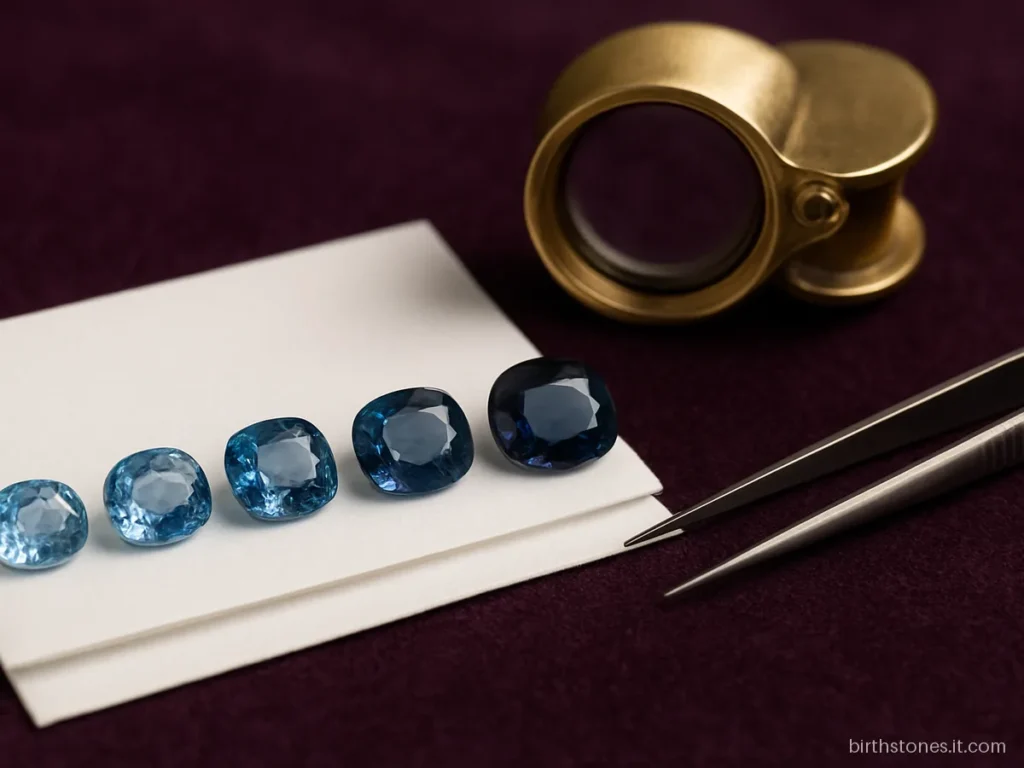
Neelam stone price is set by colour first, then clarity, cut, weight in carat or ratti, claimed origin, treatment and whether a gem lab outside the shop has tested it. A pair of sapphires weighing exactly alike may be worlds apart in value, and an unheated Kashmir or Ceylon claim can multiply a quote.
We give no figures because rates shift and no two dealers mark up alike. What follows will help you judge an original neelam stone price quote, compare two quotes properly and spot the patterns behind a fake bargain. The gem itself is explained on our neelam stone page.
Colour sets most of the neelam stone price
For blue sapphire, the shade outweighs every other factor. The top grades show a strong, velvety royal or cornflower blue that stays bright under both daylight and a tube light. Prices fall as the blue becomes inky and dark, greyish, too pale or greenish. Even colour matters too. Strong zoning, where blue sits in bands with clear areas between, lowers value unless the cutter has hidden it well.
Clarity, cut and size
Natural sapphires nearly always have something inside: fine needles called silk, small crystals, or fingerprint like healed cracks. Light silk is normal. Open cracks that reach the surface, cloudiness and dark spots reduce price and are also disliked by astrologers. A good cut returns light evenly across the stone. Many Indian astrological stones are cut deep to keep weight, which can make them look dark. Bigger stones of the same quality cost more per carat, because large clean rough is rare.
Ratti and carat in a blue sapphire stone price
Searches such as neelam stone price 7 ratti original or 5 ratti show how buyers think in ratti. One carat always equals 200 milligrams. Ratti is an older Indian unit that most dealers reckon at roughly 0.91 carat, yet a few work with a different figure, so get the ratti they mean in writing. The safest way is to ask for weight in carats with two decimals and compare per carat. Also check that the weight is for the loose stone and not the ring.
Origin claims: Kashmiri, Ceylon and others
| Claim on the bill | What to know |
|---|---|
| Kashmiri neelam | Mines produced briefly long ago. Genuine stones are rare old stock and need a strong report. |
| Ceylon or Sri Lankan | Common in India, often lighter and bright. Valued well. |
| Burmese | Can be rich blue. Origin must come from a report, not the seller's word. |
| African or Thai | Often darker and frequently heated. Usually priced lower. |
| No origin stated | Normal for most stones. Judge on colour and clarity. |
Origin is an opinion given by a laboratory after testing, and only a few stones get one.
Treatment changes the price sharply
- Unheated: highest value for the same look, and must be stated on a report.
- Heated: the common case, accepted in the trade.
- Diffused: colour mostly in a thin outer skin, worth much less.
- Glass filled: cracks filled with lead glass, fragile, worth very little as a gem.
- Lab grown: real corundum made in a factory, sold cheaply, never a natural neelam.
Most astrologers ask for natural sapphire, and many accept heating. Ask what yours accepts before you shop.
Comparing two neelam ratna price quotes
- Convert both to carats.
- Lay both on plain white paper close to a window.
- Check both reports: natural or lab grown, heated or unheated, any filler.
- Ask whether the quote includes the ring metal and making charge.
- Ask about a buy back or exchange policy in writing.
Rates differ between shops and change over time, so take two or three quotes before deciding. See gemstone certificate for what a good report contains, and pukhraj stone price if you are comparing with yellow sapphire.
Warning signs with a real neelam stone price
Be wary of a large, clean, bright blue stone at a very low price, a report from a lab you cannot verify, a dealer who will not let the stone leave for outside testing, claims of Kashmir origin without paperwork, or pressure to buy before a certain planetary date. Searches like neelam cycle price or very cheap neelam nag offers usually lead to glass or lab grown stones.
Before buying, also read neelam stone benefits for the trial custom. A stone that fails the trial is hard to sell back.
Questions people ask
What decides the neelam stone price in India?
Colour is the biggest factor, followed by clarity, cut, weight, origin claim, heat treatment and certification. Each seller also adds a different margin.
Why is a Kashmiri neelam so costly?
The Kashmir deposit produced for only a short period, so genuine stones are rare. Most stones sold with that name have no proof, so ask for a report that states origin.
Is a heated blue sapphire fake?
No. Heating is a normal treatment for natural sapphire. It lowers value compared with an unheated stone but the gem is still a real sapphire.
How should I compare a 5 ratti and a 7 ratti quote?
Convert both into carats using the same ratti value, then compare the price per carat along with colour and clarity.
Is a certified neelam always original?
Only when the paper comes from a gem laboratory whose report number you can confirm yourself, and which is not owned by the shop. Some reports are printed by the seller, so check the lab and the report number.