
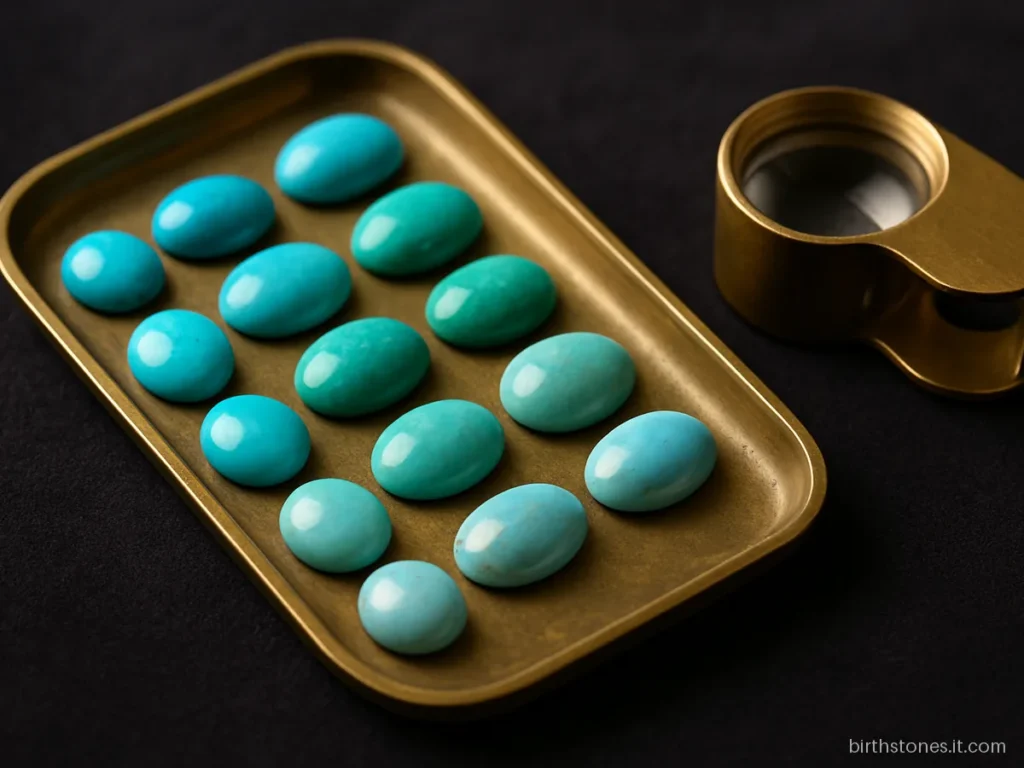
Firoza stone price comes down to five things a tester checks in turn: the blue, the hardness of the turquoise, its veining (matrix), any resin or dye, and the weight. Lay two firoza pieces of equal carat next to each other and one may fetch several times the other, which is why a bare figure says little.
You will find no amounts on this page; turquoise rates drift and each shop keeps its own margin. What you get instead is a buyer's checklist: the lines a proper bill carries, the questions that expose a dyed bead, and a fair way to line up rival offers. If you are new to the stone, start with the basics on the firoza stone page.
How to compare two firoza quotes
- Write down the exact weight and unit
Note carats; if the shop talks in ratti, get its conversion on paper. One carat is a fixed 200 milligrams; ratti varies, and many Indian jewellers treat it as about 0.91 carat.
- Match the treatment status
Put untreated beside untreated, resin filled beside resin filled. A stabilised stone quoted near a natural one is not a bargain.
- Compare colour side by side in daylight
Hold both stones on white paper by a window. Even sky blue ranks above green blue, and a chalky look ranks lowest.
- Check the cut and the back
Look for a smooth, even dome and a finished underside with no hidden glue line or backing layer.
- Ask what the paperwork covers
Find out if the report is from a lab separate from the shop, and whether it names any treatment.
What decides the firoza stone price
| Factor | Pushes price up | Pulls price down |
|---|---|---|
| Colour | Even, medium sky blue | Greenish, pale or patchy |
| Density | Hard, compact, takes a glassy polish | Soft, chalky, absorbs water |
| Matrix | Fine, even spiderweb or none | Heavy blotches of host rock |
| Treatment | Natural, untreated | Stabilised, dyed, reconstituted |
| Size | Large clean pieces | Small or cracked pieces |
| Cut | Well shaped dome, calibrated | Lumpy, thin, uneven back |
| Origin claim | Irani with a lab note | Origin unknown or unsupported |
Colour and treatment move the turquoise stone price more than anything else. A modest untreated piece often outranks a large resin soaked one.
Natural, stabilised, reconstituted and dyed
Think of turquoise as a ladder. At the top sits natural material, hard enough to cut and polish with nothing added. Below it is stabilised turquoise, porous rock soaked with clear resin to make it wearable; this is honest if declared. Further down is reconstituted turquoise, ground powder rebuilt into blocks with binder and colour. At the bottom are look alikes such as dyed howlite, dyed magnesite, glass and plastic, which are not turquoise at all. Each step down should cost clearly less. When a bill just says firoza, ask which rung you are buying.
Irani and other origin names
Irani firoza carries a premium in India because Persian mines have long given clean sky blue stones. The word is used loosely in markets, though, and good turquoise also comes from the United States, China, Tibet and Egypt. Origin is hard to prove; only a lab can offer an opinion, and many do not. Spend on the blue and the hardness in front of you, not on a mine name written on a tag.
Original firoza stone price vs imitations
When people ask about original firoza stone price, they usually want to know why one seller is far cheaper than another. Often the cheaper item is not natural turquoise. Signs to watch:
- Blue colour sitting in cracks and veins, as if poured in.
- A perfectly uniform colour across a whole strand of beads.
- Very light weight and a warm, plastic feel.
- Blue staining left behind when you rub it with moist tissue.
- A label that says turquoise colour or turquoise stone with no mineral named.
A strand of beads is priced very differently from a single loose cabochon, so do not compare them directly.
How to read a quote or bill
A useful bill names the material (turquoise), the treatment (none, stabilised, dyed), the weight with its unit, the shape and size in millimetres, and whether the price includes the metal setting and making charge. Ask for these lines in writing. If the feroza stone price is quoted per ratti, confirm the ratti value. If a seller refuses to put the treatment on paper, treat the deal as weaker, whatever the discount.
Firoza stone price in India: why it varies by seller
Rates differ between a wholesale gem market, a neighbourhood jeweller and an online seller. Rent, testing, the seller's margin, return policy and the cost of the setting all go into the final figure. Prices also change over time with supply. The only fair method is to collect several quotes, keep only stones that share a treatment and a similar shade, then weigh them up. For a wider view of turquoise and other blue options, see blue gemstones.
Lab reports and when they are worth it
For a single stone you plan to wear for years, or any piece sold as natural Irani, a report is sensible. It should identify turquoise, state any resin or dye, and give weight and measurements. Check that the report number can be confirmed by the lab directly. Our gemstone certificate guide explains each line. For inexpensive bead strings, a test may cost more than it is worth, so judge by the seller's openness instead.
Setting and care add to the real cost
Turquoise is soft and porous, so the setting matters. A closed bezel in silver or gold protects the edges. Poor care can also reduce value: oils and creams turn the blue greenish over time. Budget for a good mount and keep the stone dry. If you want something tougher in a similar colour, ask about aquamarine or blue topaz, though they look very different.
Questions people ask
Why does one firoza cost far less than a similar looking one?
Usually the cheaper one is greener, more chalky, stabilised, reconstituted or not turquoise at all. Ask each seller for the treatment in writing before comparing.
Is stabilised turquoise fake?
No, it is real turquoise that has been treated with resin to harden it. It should be priced below natural turquoise and declared on the bill.
Is firoza sold by carat or by ratti?
Both are used. One carat is 200 milligrams; ratti differs between sellers, so ask which value they mean before you compare quotes.
Does Irani firoza always cost more?
It usually carries a premium, but the name is used loosely. Pay for colour and density you can see, and treat origin as a claim unless a lab supports it.
Is testing worth it for a turquoise ring?
For a costly single stone, yes. For low priced bead strings, a frank seller and clear labelling are often enough.