
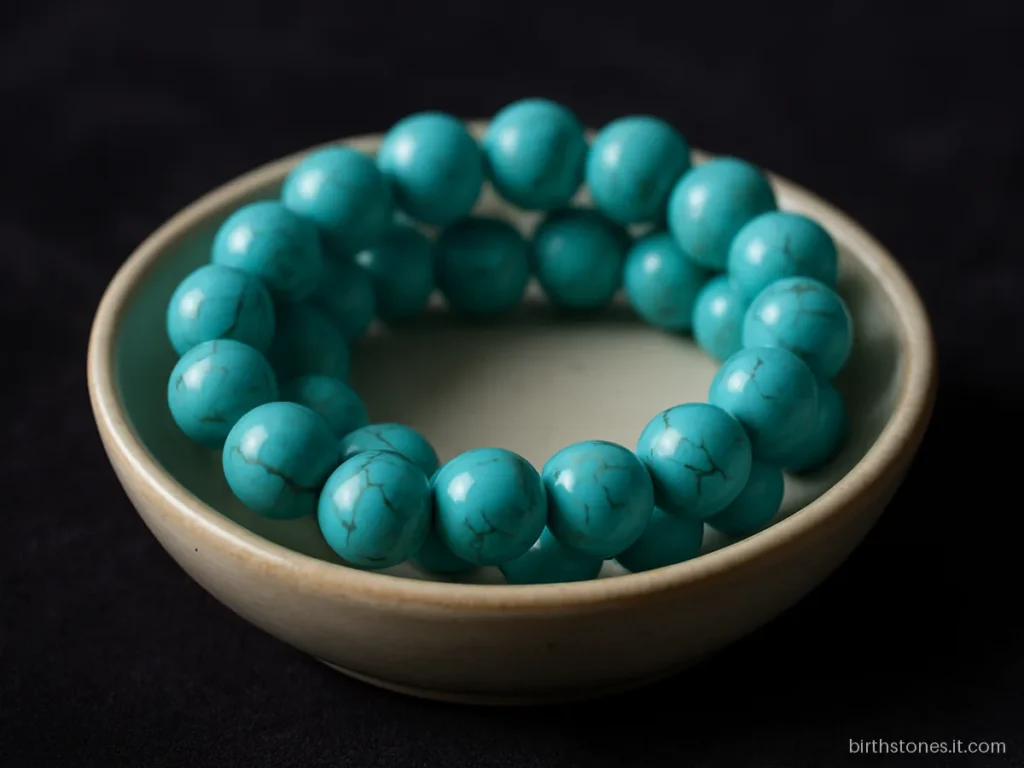
A firoza stone bracelet is a strand of turquoise beads, a copper bearing mineral whose shade runs from robin egg blue to green. Firoza, sometimes spelled feroza, is the Persian and Hindi name for turquoise, and it is the December birthstone on most modern charts.
Turquoise is soft, with a Mohs hardness of just 5 to 6, and it is porous, so it drinks up sweat, oil and perfume and can slowly turn green. It is also among the most imitated stones in the bead market. This page shows how to spot dyed howlite and resin, what stabilised turquoise means, how to size a strand and how to care for the strand. The loose gem has its own guide: firoza stone.
Checking a turquoise stone bracelet
- Look closely at the drill holes
Dyed howlite often shows white inside the hole or at chips. Real turquoise is coloured right through.
- Rub a bead with a damp cotton bud
If the bud picks up blue, the bead was stained. Do this on one bead only, gently.
- Study the dark veins
Turquoise matrix lines sit level with the surface and vary in colour. On dyed howlite the veins are grey and often sunk a little, with dye pooling in them.
- Check for a too perfect look
When every bead is the same loud blue, smooth like plastic and sold cheaply, suspect resin or stained stone. Natural beads vary in shade from one to the next.
- Ask what treatment was used
Get the seller to note on the bill if the strand is natural, stabilised, dyed or reconstituted. A seller who cannot answer is a warning.
What a firoza stone bracelet really contains
Turquoise forms where copper rich water seeps through rock over a long time. Pieces come in shades from pale sky blue to deep green, often with brown or black matrix lines from the host rock. Fine solid blue with no matrix is the most prized. Strands come in round beads from small to large, and chips or nuggets are also common. People also search feroza bracelet or turquoise stone bracelet; all mean the same stone.
Natural, stabilised, dyed or reconstituted
| Type | What was done | What it means for you |
|---|---|---|
| Natural | Only cut and polished | Rare in beads, most delicate |
| Stabilised | Soaked in clear resin to harden it | Very common, more durable, should be disclosed |
| Dyed turquoise | Pale stone coloured deeper blue | Colour may fade or rub off |
| Reconstituted | Powder pressed with resin into blocks | Cheap, uniform look |
| Dyed howlite or magnesite | A white stone dyed blue | Not turquoise at all |
Stabilised turquoise is an honest product when sold as such. The trouble comes when dyed howlite is called firoza.
Bead size and fit
Turquoise strands look best when beads are not too big, because large solid blue pieces are rare. 6 mm and 8 mm are common for women, 8 mm and 10 mm for men. Take your wrist size and allow roughly one extra centimetre, so beads do not press into the skin and soak up sweat. A knotted thread strand with a silver clasp is a good choice for a costly natural piece, since it comes off easily before washing.
Beliefs around firoza
Persians, Tibetans and Native American peoples have long valued turquoise for protection, and it is still worn that way. In India, many people wear firoza for protection while travelling and for a calmer mood, and crystal users connect it with the throat chakra and honest speech. Some astrologers suggest it too, though schools differ on its planet link, so its astrological use is a matter for a trained astrologer looking at your own birth chart.
The beliefs are covered more fully on firoza benefits.
Which hand people wear it on
Crystal followers commonly put protective stones on the left hand, saying it is the side that receives. Others wear firoza on the right hand because it is more visible while working. There is no measured difference between the two. Pick a wrist that does not get wet often, which for many is the non writing hand.
Care for soft, porous turquoise
Turquoise changes colour with the oils it absorbs, so a turquoise strand asks for gentler handling than quartz.
- Take it off before bathing, swimming, cooking and applying cream.
- Never spray perfume or sanitiser near it.
- After each wear, a dry cotton hanky is all it needs; no soap, no ultrasonic cleaner.
- Harsh summer sunlight can dry and fade it, so store it in shade.
- Store it alone, as quartz and metal scratch it.
- Restring with fresh cord when it loosens.
Other blue strands
If you want a blue look with less upkeep, lapis lazuli, sodalite and blue aventurine are compared on the blue stone bracelet page. The full list of strands is in crystal bracelet, and the December stone is explained on December birthstone.
Questions people ask
How can I check if my firoza stone bracelet is real?
Look for white at the drill holes, rub one bead with a damp cotton bud for dye, and check that the veins sit level with the surface. Perfectly identical bright beads are often imitation.
Why is my turquoise stone bracelet turning green?
Turquoise absorbs sweat, skin oil and cosmetics, which shift its blue towards green. Store it dry, and let creams soak in before you wear it.
Does stabilised mean my turquoise is not genuine?
Stabilised beads are genuine turquoise that took in clear resin to make them tougher. Most strands are made this way, and the label should say so.
Can I wear a firoza bracelet while bathing?
No. Bathwater and soap seep into the pores and alter the blue.
Which month is turquoise for?
December. Most modern month lists name turquoise first and list zircon and tanzanite beside it.