
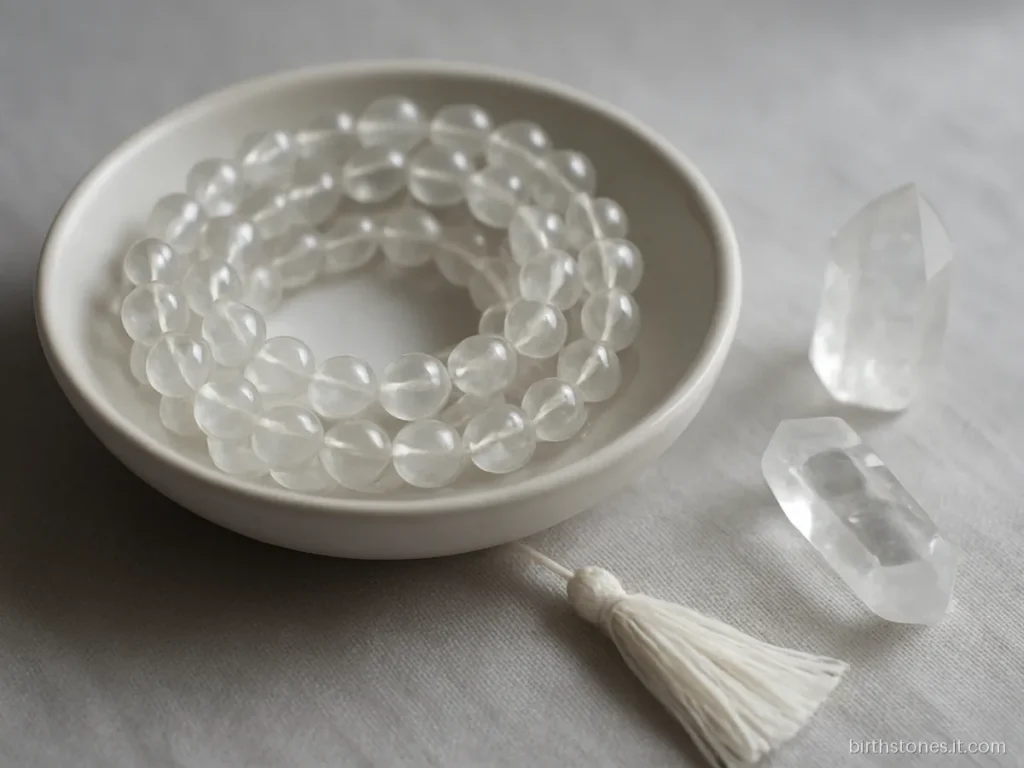
Most quartz stone benefits you hear of come as beliefs from crystal practice and Indian tradition: clear quartz is held for focus and a clear mind, rose quartz for gentle feelings, smoky quartz for feeling steady. None of these are proven by science, and quartz does not treat any illness.
What is certain is the physical side. Quartz is hard, easy to clean, widely available and comfortable to wear every day. This page explains the beliefs honestly, colour by colour, and gives practical advice on choosing and caring for a piece.
Quartz stone benefits in plain words
Crystal healers describe quartz as an amplifier, a stone that is believed to strengthen whatever intention the wearer holds. In practice people use it as a reminder: a bead on the wrist or a point on the desk that prompts them to pause, breathe and focus. Many find that habit helpful, and that is a fair way to think about it.
A crystal is a piece of rock, nothing more medical than that. When you feel ill, your doctor is the right first stop; a crystal can sit beside proper care but never replace it.
Quartz stone in Hindi and Indian tradition
People searching for quartz stone in Hindi usually want the word sphatik. Sphatik malas of clear quartz beads are worn at home and kept for quiet daily prayer, and sphatik is valued in many Indian families for its cool, pure look. In Vedic astrology (Jyotish) sphatik is sometimes linked with Venus (Shukra) and offered as a simple stone for calm. Some astrologers also name coloured quartz as upratna, lower cost substitutes, for bigger gems. Practices differ widely, so let a trusted jyotishi look at your complete kundli before choosing one.
Believed benefits by colour
| Quartz type | What crystal healers say | Common use |
|---|---|---|
| Clear quartz | Clarity and focus | Desk point, mala, pendant |
| Rose quartz | Kindness and self care | Bracelet, heart shaped stone |
| Smoky quartz | Feeling grounded and steady | Pocket stone, raw point |
| Amethyst | Calm and restful sleep | Cluster by the bed |
| Citrine | Cheer and confidence | Ring, bracelet |
| Tiger's eye | Courage and willpower | Bracelet, ring |
Each of these has its own guide: see rose quartz benefits, tiger's eye benefits and clear quartz benefits.
The real, physical advantages of quartz
- Durable: at about 7 in hardness it shrugs off dust and most daily knocks.
- Easy care: water and mild soap are safe, unlike pearl, opal or selenite.
- Affordable: quartz is common, so good pieces are within reach of most buyers.
- Many colours: one mineral gives choices from colourless to purple, pink and golden.
- Easy to test: a jeweller can confirm quartz quickly, so fakes are easier to catch.
These are facts you can rely on, whatever you believe about crystal energy.
How people wear and use quartz
The most common ways are a bead bracelet on the wrist, a sphatik mala around the neck, a small point kept on a work desk, or a tumbled stone carried in a pocket. Some people hold a stone during a few minutes of quiet breathing each morning. Others place a cluster in a room simply because they like how it catches light.
There is no single correct hand or finger for crystal practice. For an astrological stone set in a ring, the finger, metal and day are chosen by the astrologer, not by a general rule.
Cleansing beliefs and safe cleaning
Crystal users talk about cleansing a stone of collected energy, often with moonlight, sound or by placing it on a bed of rice or salt. These are rituals of belief. For physical cleaning, quartz is easy: lukewarm water and a gentle scrub, then pat it dry. Do not soak dyed beads, and avoid leaving amethyst, rose or smoky quartz in strong sunlight for days, because their colour can fade.
Who should be careful with quartz
Quartz itself is safe to wear for almost everyone. The caution is about expectations: do not stop any treatment or skip a check up because you wear a crystal, and be wary of a seller who promises money, a job, a wedding or getting well. No honest seller can promise those things. Small children should not be given loose tumbled stones, because they are a choking risk.
Choosing a good quartz piece
Look at it in daylight. Clear quartz should be bright, with only small natural veils. Bead strands should have even colour and smooth drill holes. Glass imitations feel warm quickly and show round bubbles under a loupe. The main quartz guide lists simple tests, and the healing crystals guide compares quartz with other popular stones.
Questions people ask
What are the main quartz stone benefits?
In crystal practice, clear quartz is believed to support focus and clarity, and coloured kinds are linked with moods such as calm or courage. These are beliefs, not medical facts. Its proven benefits are physical: it is hard, easy to clean and good for daily wear.
What is the Hindi word for quartz stone?
The usual word is sphatik, used mostly for colourless quartz. A sphatik mala is a string of clear quartz beads, common in Indian homes.
Can quartz improve health?
There is no scientific proof that quartz affects health. Some people find holding a stone relaxing as part of a quiet routine, but for any health concern, visit a qualified physician.
Who can wear a sphatik mala?
Anyone can wear one as an ornament. If you are wearing it on an astrologer's advice, follow the guidance given for your own chart, since schools differ.
How do I clean a quartz bracelet?
Wipe the beads with a damp cloth or wash them briefly in mild soapy water, then dry them flat. Do not soak elastic bracelets for long, because the cord weakens.
Does quartz lose its power over time?
Crystal practitioners believe a stone needs regular cleansing. Physically, quartz does not wear out, though coloured kinds may fade a little in strong sunlight.