
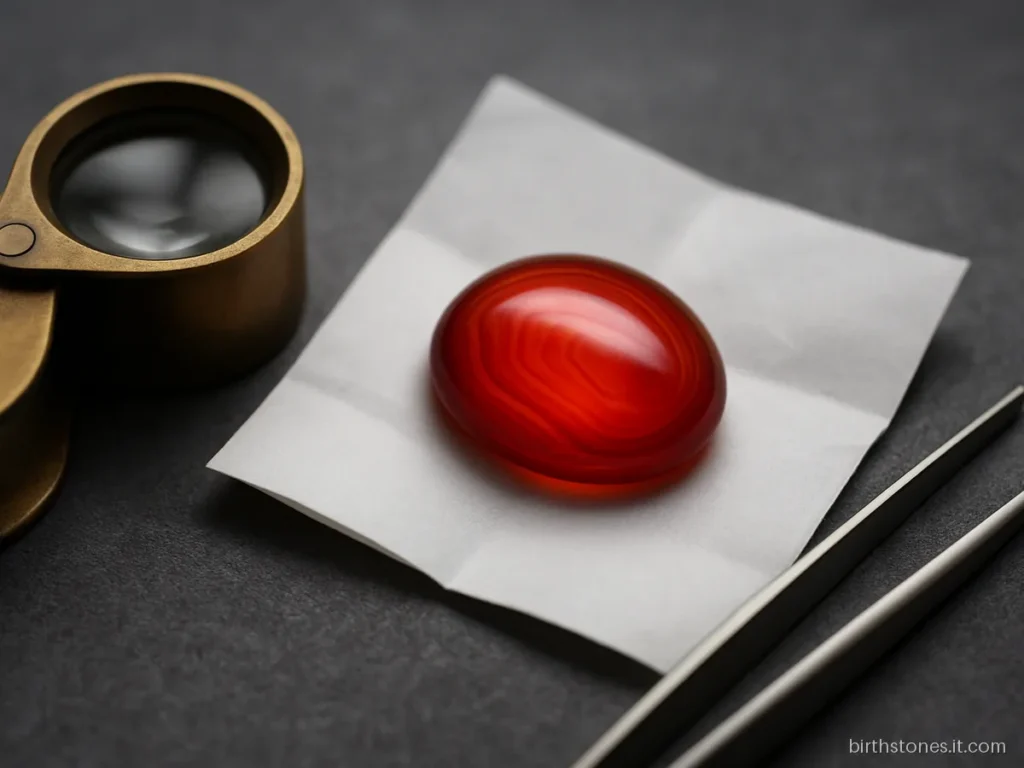
An original aqeeq stone is natural agate, and the best clues are gently varied colour bands, a cool feel and some light passing through thin edges. The word original is used loosely in shops, though, so a stone can be real agate with dyed colour, or it can be glass or plastic made to look like hakik.
This page separates those cases, gives checks you can do at home, explains honestly where those checks fail, and says when an independent lab is worth it. Background on the stone is on the main hakik page.
Simple checks for a hakik at home
- Shine a torch through the edge
Natural agate usually glows a little at thin edges and shows its bands. Dense black dyed agate may stay dark, so this is a clue, not a verdict.
- Study the bands with a loupe
Real banding curves and varies in width. Moulded copies tend to show an identical design on every piece, flat and too tidy.
- Search for bubbles
Spherical bubbles or flow swirls suggest glass or resin. Agate does not contain round bubbles.
- Feel the temperature and weight
Real stone stays cool briefly against your cheek and sits heavy in the palm. Plastic warms at once and weighs little.
- Look where dye collects
Colour that is darker along cracks, pits or the drill hole of a bead suggests dyeing.
- Send doubtful costly pieces to a lab
If a seller charges a premium for natural colour, a lab report is the fair way to settle it.
What original aqeeq stone really means
Sellers use original in three different senses, and the confusion causes most disputes:
- Real agate: the material is chalcedony, not glass or plastic. Most hakik sold in India passes this.
- Natural colour: the stone is agate and its colour has not been added. This is much less common for black, green and blue.
- Claimed origin: for example Yemeni. This cannot be confirmed by eye.
When you ask is this original, ask which of the three the seller is promising, and get it in writing.
Sulemani hakik stone original or dyed
Grey banded agate soaks up a sugar solution, and a later acid bath turns the sugar to carbon inside the porous layers, giving deep black stripes next to white ones that do not absorb. This method is centuries old, and most sharp black and white sulemani in markets is made this way. It is still real agate; the colour is just enhanced. A naturally dark and white banded stone tends to be softer in contrast, more brownish black, with some uneven bands. Only a lab can say with confidence which you have.
Natural vs dyed vs glass: a comparison
| Sign | Natural agate | Dyed agate | Glass or plastic |
|---|---|---|---|
| Colour | Earthy, changes band to band | Strong, very even, sometimes neon | Even, often too bright |
| Light through edge | Soft glow, bands visible | May be blocked by dark dye | Glows evenly, no real bands |
| Under a loupe | Fine fibrous texture, tiny pits | Dye in cracks and pits | Round bubbles, mould marks |
| Feel | Cool, solid | Cool, solid | Glass cool, plastic warm and light |
| Lab result | Agate, natural colour | Agate, dyed | Glass, plastic or resin |
Read the table as a set of clues. One sign alone rarely decides anything; several pointing the same way are more telling.
Why home tests have limits
Every home check has a weak spot. Dyed agate is still agate, so it feels cool, weighs right and resists scratches just like natural stone. Good glass can feel cool too. Torch tests depend on thickness and colour. Rubbing with acetone sometimes lifts surface dye, but fixed dyes do not move, and the solvent can damage resin fillings or lacquer, so we do not recommend it on a stone you care about. Scratching a stone with a knife or on glass risks chipping it and proves little. Use home checks to decide whether to ask more questions, not to issue a final verdict.
Water, salt or fire tests shown in videos do not identify agate. Heating can crack the stone.
How a lab confirms an original aqeeq stone
A gem lab measures refractive index and specific gravity, which place the stone in the chalcedony family, then looks at it under magnification and sometimes with spectroscopy to detect dye and heating. The report names the material and lists any treatment. Pick the lab yourself rather than the one the shop suggests. The gemstone certificate page walks through each line of such a report.
Sulemani hakik stone original: buying tips
- Buy from a seller who states natural or dyed without being asked twice.
- Prefer stones with some natural variation over ones that look printed.
- For a bead mala, check several beads; fakes are often mixed into real strings.
- Keep the bill with the stone description and weight.
- If a premium is asked for natural colour, make the sale conditional on a lab result.
The aqeeq price guide shows how dyeing and other factors change a fair quote, and the onyx page covers the closely related black stone.
Common fake hakik types you may see
Market fakes fall into a few groups. Moulded glass cabochons in red or black are sold as aqeeq rings at fairs. Resin and plastic beads appear in very cheap bracelets. Some sellers offer reconstituted stone, made from crushed agate bound with resin, which has a grainy look under a loupe. Painted or coated stones show colour only on the surface, and a chip reveals a different colour beneath. None of these are agate in the full sense, even if they carry the hakik label.
Questions people ask
How do I tell whether an aqeeq ring is original?
Look for natural banding, some translucency and no bubbles under a loupe, then confirm with an independent lab for anything costly. Home checks only narrow down the answer.
Is dyed hakik fake?
No, dyed hakik is real agate with added colour. It is only misleading if it is sold as natural colour.
Is sulemani hakik stone original if it is very black?
Very deep, even black with bright white bands is usually the result of a traditional dye process. The stone is still agate.
Does a real agate stone float or melt?
No, agate sinks in water and does not melt with a lighter. These videos do not prove anything and heat can crack the stone.
Can a jeweller test hakik in the shop?
An experienced jeweller can often spot glass or plastic quickly. Detecting dye with confidence usually needs lab equipment.
Does a certificate prove an original aqeeq stone?
Only a paper from a lab unconnected to the shop settles material and treatment. A counter printed card carries far less weight.