
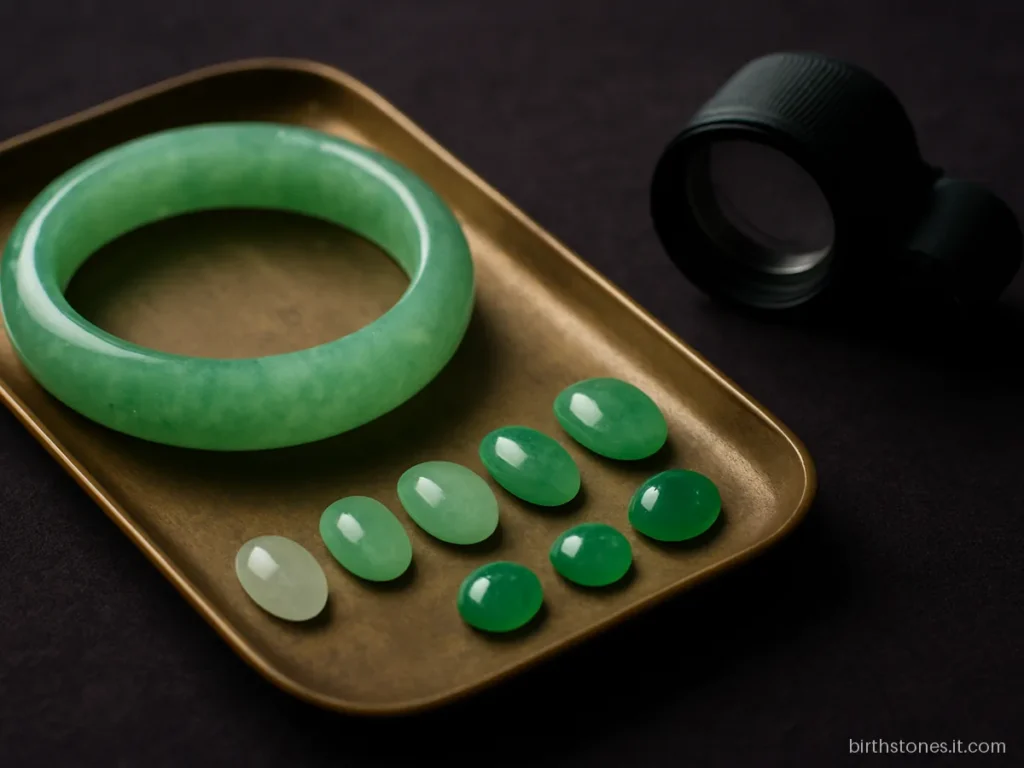
Jade stone price depends first on whether the piece is jadeite or nephrite, then on colour, translucency, texture, treatment and the skill of the carving. Fine untreated jadeite with an even, glowing green is among the costliest gem materials anywhere, while dyed quartz sold as jade is very cheap, and the two can look surprisingly alike in a shop window.
We do not quote figures, because they change constantly and vary widely between sellers. This guide shows you what a fair quote should reflect, how jade stone price in India is usually presented, and how to avoid paying a jade charge for a jade lookalike. For background read the jade stone guide.
Reading a jade quote step by step
- Confirm the mineral
The bill should say jadeite, nephrite or the actual lookalike name. Jade alone is not enough.
- Ask for the treatment grade
For jadeite, A, B or C changes value hugely. Get it in writing.
- Check size against form
Bangles are priced by inner size, width and how much stone they use; ring stones by size and weight.
- Separate metal and making
For set pieces, have the stone and the gold or silver listed apart.
- Compare like with like
Only compare two jade quotes when the mineral, grade and size match.
- Make big buys subject to testing
Agree that you can return the piece if a lab finds dye or resin not disclosed.
What decides jade stone price
Traders weigh these points, roughly in this order:
- Jadeite or nephrite: fine jadeite generally sits well above nephrite, though top white nephrite has its own market.
- Colour: pure, intense, evenly spread green is valued most; lavender, white and black follow depending on fashion.
- Translucency: a stone that glows as light enters it is worth much more than an opaque one.
- Texture: fine, smooth grain beats coarse, sugary grain.
- Treatment: untreated A jade carries a big premium over B or C material.
- Flaws: cracks, black spots and cloudy patches lower value.
- Size and form: a full bangle needs a large clean piece of rough, which raises cost.
- Craftsmanship: detailed carving and fine polish add labour value.
Jade stone price in India: how it is sold
Indian sellers offer jade in a handful of forms, each with its own pricing logic.
| Form | Usual basis | Key price factors |
|---|---|---|
| Ring stone or cabochon | Per piece or carat | Colour, translucency, grade |
| Bangle | Per piece | Mineral, colour spread, cracks, inner size |
| Bead strand or mala | By the strand | Bead size, matching colour, whether dyed |
| Carving or pendant | Per piece | Material plus carving skill |
| Tumbled crystal | Per piece or weight | Often a lookalike, check name |
Most low cost green jade crystal pieces in India are nephrite of everyday quality or a lookalike. That is not wrong, as long as the label is honest.
A, B and C jade and their effect on price
Jadeite treatment is usually described with letters. A jade is natural, only waxed on the surface. B jade has been bleached with acid to remove brown stains and then filled with polymer resin to restore strength. C jade has added dye. B plus C is both. Treated pieces can look brighter than natural ones, yet they are worth only a small part of a comparable A piece and may yellow or crack over time. Only advanced lab testing can reliably spot polymer filling.
When a seller cannot tell you the grade, assume treatment until a lab says otherwise.
Original jade stone price vs imitation
The big risk with jade is not overpaying for a good stone but paying a jade figure for something else. Dyed quartzite, serpentine, green aventurine and glass all turn up under jade labels. They are not worthless, and they are pretty, but they are different products with much lower value. Signs to watch include a very even neon green, dye collected between grains, light weight for the size and a bill that only says green stone. Our main jade guide has a table of lookalikes, and aventurine has its own page.
Is a lab report worth it for jade
For jadeite of any real value, yes. An independent gem lab can tell jadeite from nephrite and lookalikes, and can detect resin and dye that the eye cannot see. For a small nephrite bead bracelet bought as a gift, a trusted seller may be enough. How to read such a report is covered under gemstone certificates.
Warning signs when buying jade
- The seller cannot say whether it is jadeite or nephrite.
- An unusually bright green bangle offered as a bargain.
- Words like Burma jade with no grade or report.
- A promise of luck, wealth or health if you buy.
- No return allowed even if testing finds treatment.
Remember that jade quotes rise and fall and depend on the seller, so ask several shops, compare only matching items, and keep every bill.
Jade compared with other green stones on value
Buyers often weigh jade against emerald and peridot. Emerald value rests on transparent colour and clarity, peridot is usually more modest, and jade value rests on translucency and texture. A good comparison helps you decide which green fits your budget and use. See green gemstones for a wider view.
Questions people ask
Why does jade stone price vary so much?
Two pieces called jade may be different minerals, different treatment grades or even a lookalike. Colour, translucency and texture also vary greatly.
What is the original jade stone price in India based on?
It rests on mineral type, colour, translucency, treatment grade, size and finish, plus the seller's margin. No single figure applies, so compare several sellers.
Is nephrite cheaper than jadeite?
Usually, yes, at the same quality level, though fine white or green nephrite can still be valuable.
What is B jade?
B jade is jadeite that was acid cleaned and then injected with resin. It looks clean but is worth far less than untreated jade and may age badly.
How can I avoid paying for fake jade?
Ask for the mineral name and treatment grade in writing, check for dye under a loupe and test anything costly at an independent lab.
Does a jade bangle cost more than beads?
Often, because a bangle must be cut from one large clean piece of rough, which is scarcer than material for beads.