
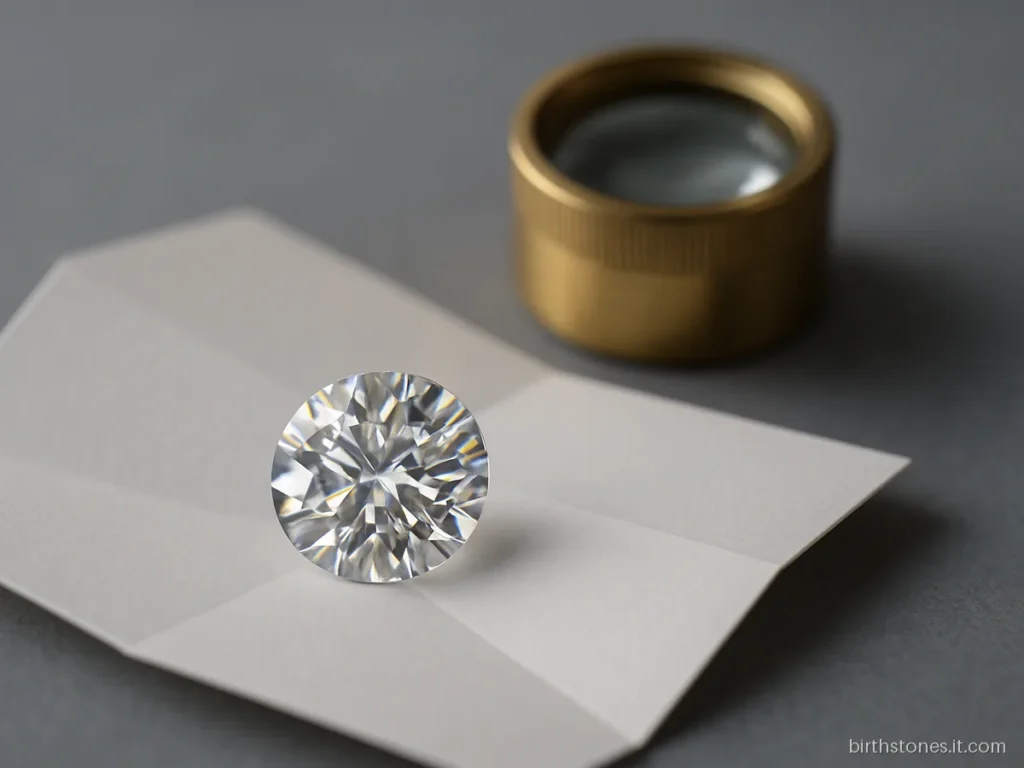
A diamond stone is pure carbon squeezed into a crystal deep inside the earth, which makes it the hardest natural gem, rated 10 on the Mohs scale. Indians call it heera, April claims it on most modern month lists, and Vedic astrology connects it with Venus.
This guide is about the gem itself: its colours, the four Cs a grader uses, where it is mined, how lab grown diamonds and imitations differ, and how to keep one sparkling. Beliefs about wearing heera have their own page at diamond benefits, and pricing logic is on the diamond price guide.
Simple checks before sending a diamond to a lab
- Breathe on the stone
A diamond spreads heat fast, so the mist from your breath vanishes almost at once. On glass or cubic zirconia it lingers for a second or two. Treat that as a clue only.
- Look at the facet edges with a loupe
Diamond edges stay razor sharp for decades. Soft imitations show rounded or scratched edges.
- Look through the side at an angle
Moissanite splits light so the back facets look doubled. A diamond does not do this.
- Ask the jeweller to use a tester
A thermal tester catches glass and CZ, but moissanite can pass it. Electrical testers or a lab are needed for that.
- Insist on a grading report
Only lab equipment can tell natural from lab grown with certainty.
What makes a diamond stone different from other gems
Diamond is the only gem made of a single element. Its carbon atoms are locked in a tight, cube based pattern, which gives it unmatched hardness, a high shine called adamantine lustre, and strong dispersion, the flashes of rainbow colour known as fire. Yet a sharp blow along one of its cleavage planes can split off a flake, so hardness and toughness are not the same thing.
Heera stone names and grades
| Term | Meaning |
|---|---|
| Heera, hira | Hindi name for diamond |
| Solitaire | A single larger diamond set alone |
| Melee, chura | Very small diamonds, often used in clusters |
| Polki | Uncut or flat cut diamond used in traditional jewellery |
| Natural diamond gemstone | Mined from the earth, formed over geological time |
| Lab grown diamond | Real carbon diamond made in a factory by HPHT or CVD |
Graders use the four Cs. Colour runs from D (colourless) down the alphabet to Z (light yellow or brown). Clarity runs from flawless through VVS and VS to SI and I, depending on how visible the inclusions are. Cut is about proportions and polish. Carat is weight, with one carat equal to 0.2 gram.
Colours: white, yellow, blue and red diamond gemstone
- Colourless and near colourless: what most people picture; the less tint, the scarcer.
- Yellow and brown: caused mainly by nitrogen; deep canary yellow is sold as a fancy colour.
- Blue diamond gemstone: coloured by traces of boron; natural blues are very rare.
- Pink and red diamond gemstone: the colour comes from strain in the crystal; natural red is among the rarest gems on earth.
- Green and black: green from natural radiation, black from dense inclusions.
A good share of the vivid fancy colours in shop windows owe their shade to treatment or a growing machine; the report tells you which.
Where natural diamond stone is mined and cut
For many centuries India was the only known source, with famous stones coming from river gravels around Golconda in the Deccan. A working mine still exists in the Panna district of Madhya Pradesh. Today most rough comes from Russia, Botswana, Canada, Australia, South Africa, Angola and Congo. India's big role now is cutting: workshops in Surat and Mumbai polish a very large share of the world's diamonds.
Natural, lab grown and imitation stones
| Stone | What it is | Clue |
|---|---|---|
| Natural diamond | Mined carbon crystal | Report says natural |
| Lab grown diamond | Same carbon, made by HPHT or CVD | Laser inscription or report; looks identical |
| Moissanite | Grown silicon carbide crystal | Doubled back facets, strong rainbow fire |
| Cubic zirconia (CZ) | Cheap synthetic look alike | Heavier, scratches with age, too much fire |
| White sapphire | Natural corundum | Less sparkle; used as heera upratna |
| Glass | Imitation | Rounded edges, bubbles |
A lab grown stone is a real diamond, just not a natural one, and should be sold and priced as such. A white sapphire is a common astrological substitute.
Diamond birthstone month and Indian astrology
Diamond is the April stone on most modern month charts, and sun sign lists usually pair it with Aries. In Jyotish, heera is the gem of Venus (Shukra), the planet astrologers link with beauty, comfort and partnership. It is traditionally associated with Vrishabh (Taurus) and Tula (Libra) rashi, where opal or white sapphire are named as alternatives. These links are belief and custom. Because a Jyotish rashi depends on your lunar sign rather than the calendar month, a capable astrologer should confirm it before you choose heera on that basis. The other eight gems are on navratna stones.
Treatments to know about
Diamonds may be laser drilled to remove dark spots, fracture filled to hide cracks, or treated with heat and pressure to change colour. Irradiation followed by heating can produce blue, green, pink or yellow tones. Some cheap stones are coated. A reputable grading report lists these. Filled stones need extra care because heat from a jeweller's torch can damage the filling.
Keeping a heera bright
Diamonds attract grease, so lotion and soap film dull them quickly. Leave the jewellery for twenty minutes in a small bowl of soapy, warm water, then work a soft brush under the setting, rinse and dry. Store diamonds apart from other jewellery, since they will scratch every other gem and even each other. Check the prongs every few months.
Questions people ask
What is a diamond stone called in Hindi?
Heera, also spelt hira, is the everyday word. Very small diamonds are often called chura or melee in the trade.
Which month has diamond as birthstone?
April, on nearly every modern chart. Western sun sign lists usually pair it with Aries as well.
Are factory made diamonds real?
Yes, a grown stone is genuine carbon diamond with the same hardness and sparkle. It is not natural, and the seller must say so.
Are red and blue diamonds natural?
Natural ones exist but are extremely rare. Most vivid red or blue pieces you will be offered were coloured by treatment or grown in a factory, so check the report.
How can I tell a diamond from CZ at home?
Try the breath test and look at the facet edges, but neither is proof. A jeweller's tester or a lab report gives a clear answer.
Can a diamond break?
Yes. It resists scratches better than any gem, but a hard knock in the wrong direction can chip it.